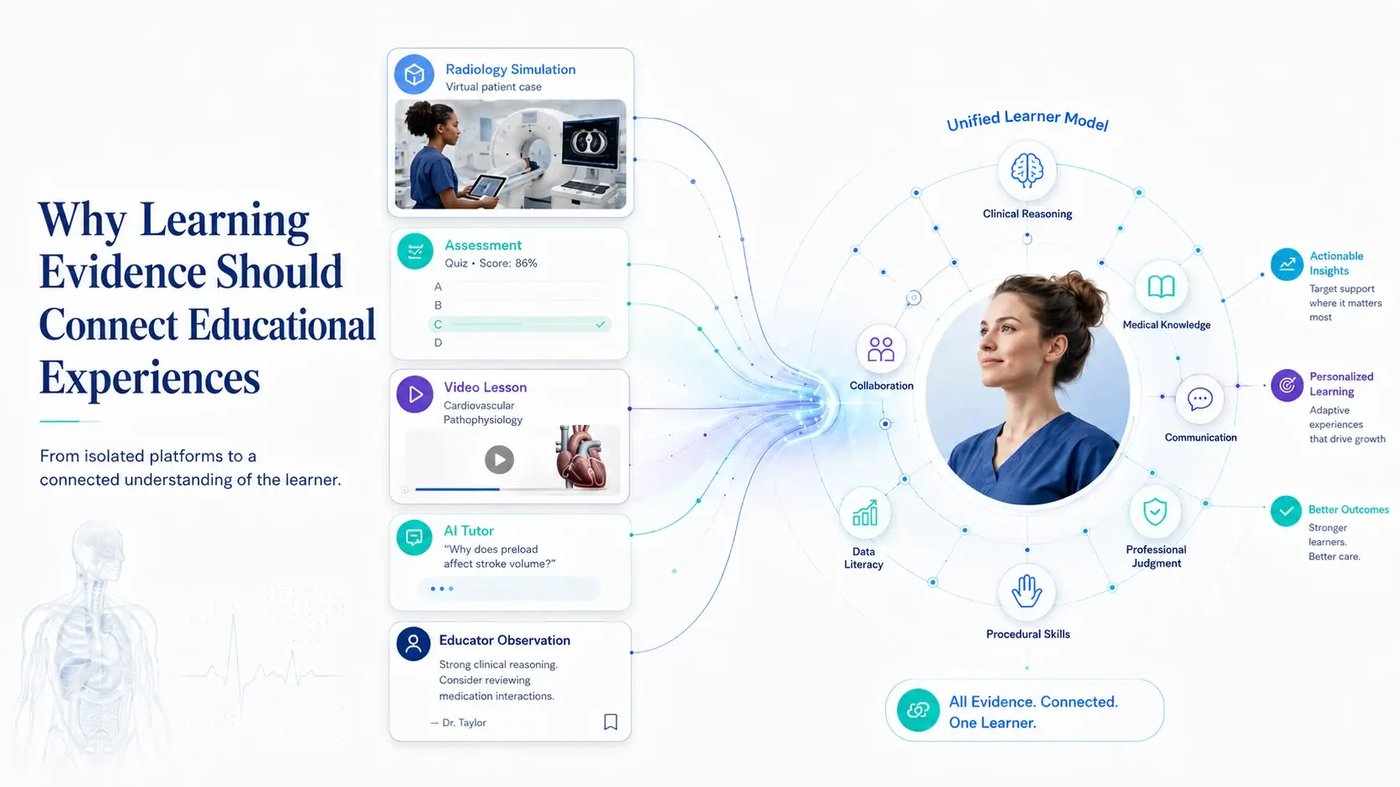
Learning is happening across disconnected systems
A connected understanding of the learner
A learner may complete a simulation, watch a video, pass a quiz and ask an AI tutor for help. Each experience produces useful information, but that evidence often remains confined to the system in which it was created.
The result is a collection of separate records rather than a connected understanding of the learner.
The problem with disconnected learning systems
Most educational technologies are designed to perform a specific function.
- An LMS delivers and tracks courses.
- An assessment platform records answers and grades.
- A simulation platform captures practical performance.
- A video platform records viewing activity.
- An AI tutor responds to questions and provides explanations.
Each system can be valuable on its own. The problem is that the evidence created within one system is rarely understood by another.
An educator may see that a learner passed an anatomy quiz but struggled during image evaluation. A simulation may show poor positioning. An adaptive lesson may identify uncertainty about exposure factors. An AI tutor may repeatedly explain the same misconception.
Each system holds part of the learner’s story, but the educator is often left to assemble the wider picture manually.
Education does not lack data
Education already produces large amounts of data.
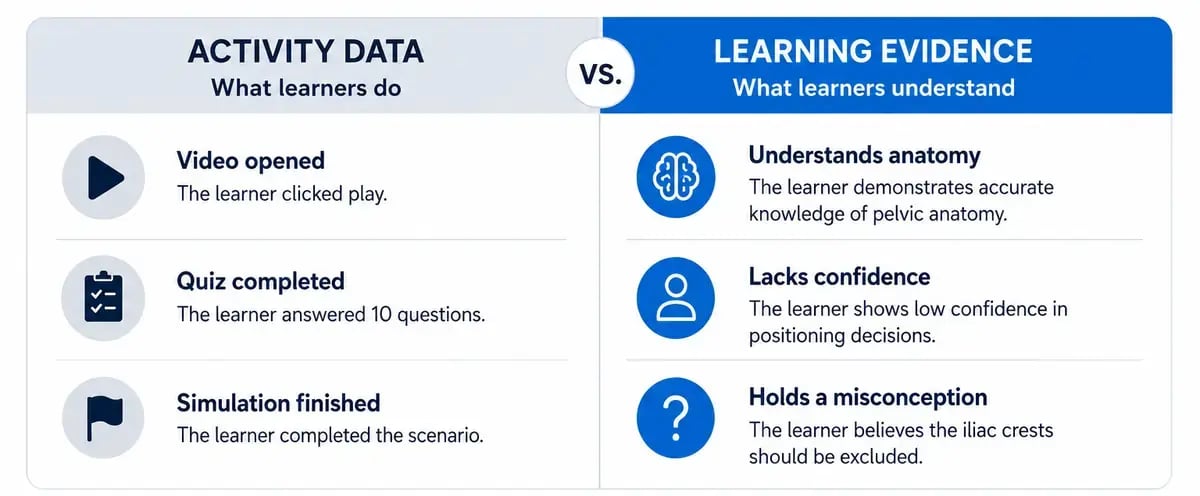
The challenge is that much of it is activity data rather than learning evidence.
Activity data tells us what happened
- A video was opened.
- A question was answered.
- A simulation was completed.
- A lesson was viewed.
- A learner spent time on a page.
Learning evidence helps us interpret what those activities may mean
- The learner can identify the relevant anatomy.
- The learner is uncertain about image quality.
- The learner understands a rule but cannot yet apply it.
- The learner holds a persistent misconception.
- The learner performs well with guidance but struggles independently.
- The learner is improving in one skill while remaining weak in another.
More data does not automatically lead to better educational decisions. Data becomes useful when it can be interpreted as evidence about learning.
Evidence should connect different experiences
A connected learning environment would use evidence as a shared language between educational systems.
- A simulation may contribute evidence about practical performance.
- An adaptive lesson may contribute evidence about knowledge, confidence and misconceptions.
- A video may reveal which concepts a learner revisits.
- An assessment may contribute evidence about recall, application or reasoning.
- An AI tutor may reveal where repeated explanation is needed.
- An educator may add observations from clinical or classroom practice.
These experiences do not need to become the same type of software. They do not need to lose their individual strengths.
They need a way to contribute to a shared understanding of the learner.
This changes the role of educational technology. The purpose of a simulation is not only to deliver an experience. The purpose of an assessment is not only to generate a mark. The purpose of an adaptive lesson is not only to select the next question. Each experience becomes a source of learning evidence.
From isolated results to a developing learner model
Evidence becomes more useful when it accumulates over time.
A single answer may be uncertain. A repeated pattern across different experiences is more meaningful.
For example, a learner may correctly identify image rotation in a quiz but fail to recognise it during a simulated examination.
That difference matters. It may show that the learner understands the concept in theory but cannot yet apply it under realistic conditions.
A traditional system may record one correct answer and one incorrect action.
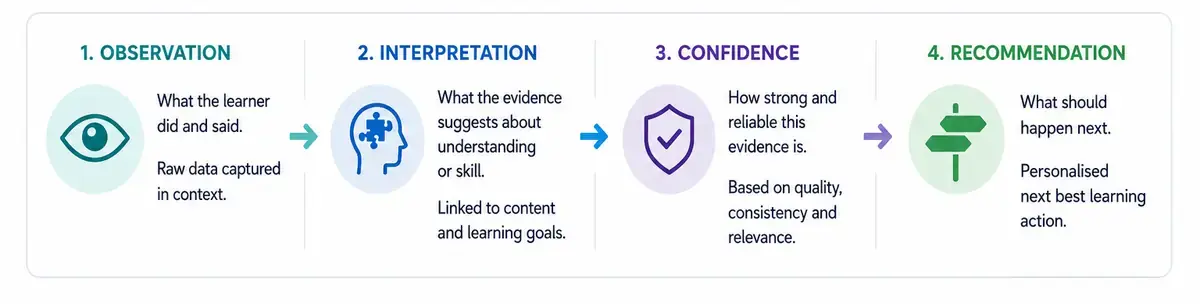
A more connected system should ask
- Were both activities assessing the same skill?
- Was one activity more difficult than the other?
- Did the learner receive guidance?
- How confident was the learner?
- Has the same pattern appeared before?
- Is the available evidence strong enough to support a conclusion?
- What activity would provide the most useful next evidence?
The aim is not to label learners permanently.
The aim is to maintain a careful and evolving understanding that changes as new evidence appears.
Evidence must remain explainable
A system that makes recommendations about learning should be able to explain why.
An educator should be able to see why a learner was directed to a particular activity.
A learner should be able to understand why additional practice has been recommended.
A recommendation should not be presented as certainty when the available evidence is weak.
This is especially important when artificial intelligence is involved.
AI can help identify patterns, generate explanations and recommend future activities. It should not invent facts about a learner or hide the basis for a decision.
A responsible evidence model should be built around clear principles
- Observations should remain traceable to their source.
- Conclusions should remain separate from raw evidence.
- Uncertainty should be visible.
- Recommendations should be explainable.
- Models should change when new evidence contradicts earlier conclusions.
- Learners and educators should be able to challenge or correct the record.
Trust should not be added later. It needs to be part of the design from the beginning.
What this could mean for learners
For learners, connected evidence could create a more coherent educational experience.
Instead of moving between separate lessons, assessments and simulations, each activity could contribute to a continuous learning journey.
A learner could see
- What they appear to understand.
- Which skills are developing.
- Where uncertainty remains.
- Which misconceptions may be affecting performance.
- What evidence supports those conclusions.
- What they should practise next.
The system could adapt across experiences rather than only within a single lesson.
A learner who demonstrates a skill during simulation may not need to repeat a basic explanation elsewhere.
A learner who repeatedly struggles with the same concept could receive targeted support before the difficulty affects more advanced learning.
The purpose is not to remove the educator.
It is to give learners and educators a clearer picture of progress.
What this could mean for educators
Educators already interpret evidence from many sources.
They review grades, simulation reports, written work, practical performance, attendance and individual conversations.
Much of the value comes from their ability to connect these signals.
Educational technology should support that professional judgement rather than replace it.
A connected evidence model could help educators identify
- Learners who are progressing but lack confidence.
- Learners who appear successful but have fragile understanding.
- Misconceptions affecting several areas of performance.
- Skills demonstrated in one setting but not another.
- Areas where more evidence is needed before intervention.
- Patterns that may be difficult to see across separate systems.
The educator remains responsible for interpretation, context and support.
The technology provides a stronger and more connected evidence base.
Virtual Medical Coaching’s direction
Virtual Medical Coaching has spent years developing immersive and simulation-based learning experiences.
Simulation makes practical performance visible. It captures decisions, actions and outcomes that traditional educational systems often miss.
However, simulation is only one part of learning.
Learners also build knowledge through video, adaptive lessons, assessment, tutoring, feedback and real-world practice.
These experiences should not remain disconnected.
VMC is exploring how evidence from different learning environments can contribute to a more unified understanding of each learner.
We believe the future of personalised learning will not come from adding more isolated platforms.
It will come from connecting the evidence those platforms produce.
The shift ahead
Education has traditionally been organised around institutions, courses, subjects and systems.
Learners do not develop in silos.
Knowledge, confidence, misconceptions, reasoning and practical performance interact continuously.
Learning technology should reflect that reality.
Evidence offers a way to connect experiences without forcing them into a single application.
It allows each learning environment to contribute what it observes best.
It creates the possibility of a learner model that develops over time.
It gives educators a stronger basis for support.
It gives learners a clearer understanding of where they stand.
The next generation of learning technology should not simply deliver more content.
It should help us understand what learning experiences reveal.
Every learning experience should contribute evidence.
Every piece of evidence should improve our understanding of the learner.
Every educational decision should be grounded in what has actually been observed.
What is learning evidence?
Learning evidence is information that helps educators and learners understand what a learner knows, understands and can do. It may come from assessments, simulations, videos, adaptive lessons, tutoring interactions or educator observations.
How is learning evidence different from activity data?
Activity data records what happened, such as opening a video or completing a lesson. Learning evidence helps interpret what that activity may reveal about knowledge, confidence, misconceptions, reasoning or practical performance.
Why should evidence connect across educational systems?
Connecting evidence across systems can provide a more complete understanding of the learner. It allows evidence from simulation, assessment, video, tutoring and educator observations to contribute to the same developing picture of progress.
Does connected learning evidence replace educators?
No. It should support professional judgement by helping educators identify patterns, uncertainty and areas where further evidence or intervention may be needed.
How should artificial intelligence use learning evidence?
Artificial intelligence may help identify patterns, explain recommendations and suggest future learning activities. Its conclusions should remain traceable to evidence, uncertainty should be visible, and educators and learners should be able to challenge or correct the record.